
Color perception: red-green weakness
Color perception: red-green weakness
Did you know that we perceive colors very differently?
Researchers have found that the perception of color differs even between women and men. Men see more "bluish" than women.
But what is it like to have red-green weakness?
Color perception in case of red-green weakness
In addition to the fact that people perceive colors very differently, there are also individuals who cannot recognize or distinguish certain colors at all. This is commonly referred to as “color blindness.” There are various forms of this condition, the most common being what is known as red-green color weakness.
This visual impairment is genetic and causes those affected to have difficulty distinguishing between red and green.
How is that possible?
In order to better understand this phenomenon, we must first explain how our eyes perceive colors.
Our retina plays a decisive role in this process because it contains light-sensitive sensory cells consisting of rods and cones.
The rods are responsible for light-dark vision and the cones for the perception of the different colors.
The cones only become active when there is sufficient light. Depending on the wavelength of the light, the cones perceive green, blue or red tones.
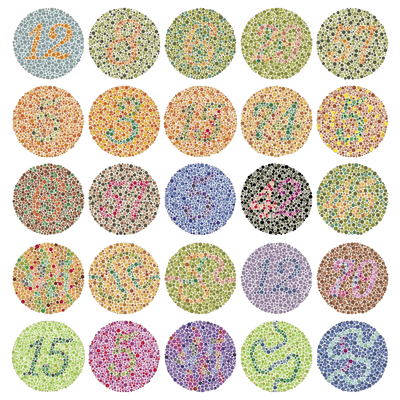
Test your color vision:
Find out here what other vision tests you can do on your own: eyetest
So what is causing the Red-Green weakness?
People who have a red-green weakness only partially form the protein opsin. However, this protein is needed for red and green-sensitive cones. Therefore, the visual area of the brain does not perceive the colors red and green at all or only very weakly.
The numbers and patterns in the picture cannot be recognized well or not at all.
Since the red-green weakness is genetically caused, there is hardly any chance of healing. Nevertheless, those affected can cope well with their everyday life with this colour sense disorder.
Eye exercises for other visual impairments
This is not the case with ametropia, which are not genetically predisposed and in most cases only represent a functional disorder of the visual system.
That’s why vision problems can be corrected with regular training. So if you’re nearsighted or farsighted, have astigmatism, or struggle with eye coordination, you’ll find the right exercises and helpful tips in our online visiontraining program.

INFORMATION
93% of our members recommend us!


*The rate of success from vision training is different from individual to individual and is not guaranteed.