
What are Symptoms for dry eyes?
What are Symptoms for dry eyes?
Your eyes feel dry and rough, like you have something in your eyes? Then you could have dry eyes.
Other possible signs include: red, itchy, burning eyes, increased eye watering, feeling of pressure and pain in your eyes.
What is the CAUSE of tired or dry eyes?
The symptoms of dry eyes stem from an imbalance in the quality and quantity of tears. The moisture level of the eyes is regulated by the balance of tear production and tear loss due to evaporation and their drainage.
One of the main causes of dry eyes is the significant use of computers. During computer screen work, people forget to blink their eyes regularly and therefore get dry eyes.
Besides, wearing contact lenses or laser surgery are common reasons for dry eyes.
A wide range of common medicines and prescription or non-prescription drugs lead to dry eyes. This is especially true for:
1. diuretics (medicines for high blood pressure)
2. antihistamines and decongestants
3. beta blockers
4. sleeping pills
5. birth control pills
6. antidepressants
7. isotretinoin-based acne medications
8. opiate-based pain relievers like morphine
A deficiency of vitamin A can also lead to dryness of the conjunctiva. In addition, tobacco smoke, car exhaust fumes, air conditioning, drafts, older age, diseases such as conjunctivitis, diabetes, thyroid disorders, autoimmune diseases, rheumatism, Sjögren’s syndrome and dry indoor air can be causes of dry eyes.
How does dry eyes develop? (What causes dry eyes?)
Tears are produced via two different methods. First, tears are produced slowly and evenly for normal eye lubrication, to form a lubricating layer. Second, tears are produced in high volume due to irritation or emotion.
Every time you blink, tears moisten and lubricate your eyes. Tears are secreted by glands above the eye. The tear film is made up of a delicate balance of three layers: A lipid layer (fat layer), a watery layer, and a mucus layer (mucin layer).
The lipid layer, formed by the meibomian glands, is the outermost layer of the tear film. Its main function is to reduce evaporation of the aqueous layer and to form an optically effective and smooth boundary layer.
The aqueous layer consists of 98 percent water and is mainly produced by the lacrimal glands. It cleanses the cornea, flushing all foreign and irritating bodies, such as dust, out of your eyes.
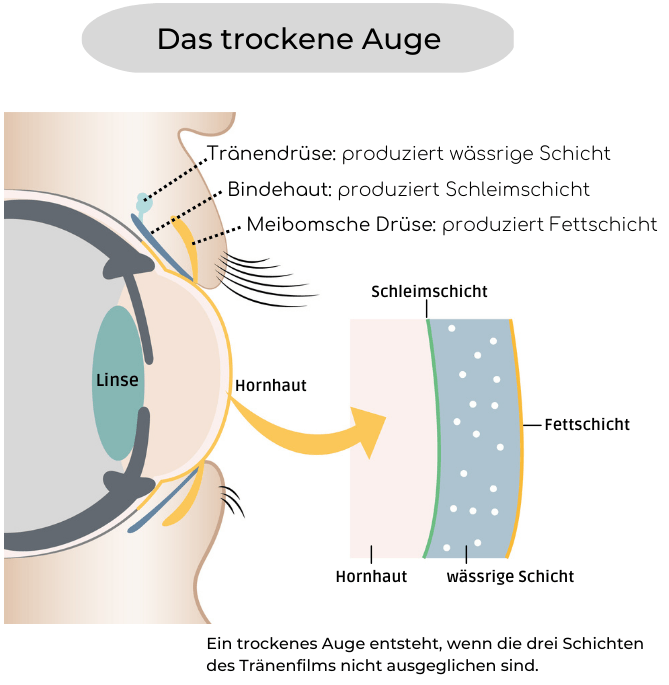
The mucus layer is produced by the conjunctiva. The mucus ensures that the aqueous layer can spread evenly over the surface of the eye and helps keep the eye moist.
Without the mucus, tears would not adhere to the eye.
How are dry eyes tested?
Dry eye treatment
To determine if you have dry eyes, several tests can be done. One of these is the Schirmer test (according to Otto Schirmer), in which a strip of filter paper (litmus paper) is placed in the outer corner of the conjunctival sac to measure the amount of tear production under different conditions. Another test uses diagnostic drops (fluorescein or bengal pink) to look for defects in the eye to localize dry spots.
Over-the-counter preparations such as “artificial tears” are among the most common remedies for dry eyes. If you use eye drops more often than every two hours, you should make sure that you use preservative-free preparations.
What you can do alternatively for dry eyes and which home remedies have proven to be effective you can learn in our pdf, which you can download here.

INFORMATION
93% of our members recommend us!


*The rate of success from vision training is different from individual to individual and is not guaranteed.