
Stressed computer-tired eyes? Here comes help!
Stressed computer-tired eyes? Here comes help!
You probably know this too: after hours of staring at the screen of your PC, laptop, tablet or smartphone, your eyes burn. They are stressed and tired. You can no longer see clearly, only blurred. As more and more people are spending more and more time in front of screens, we are now talking about a “digital disease”. According to experts, digital eye strain is becoming a serious health problem. It's not just Generation Y (born between 1980-1977) that is affected. Many people are familiar with computer fatigue. The term “computer eyes” has even become established.
In our course we show you what you can do to relieve your eyes.
You can find a few quick tips further down in the article.
These symptoms develop due to computer fatigue and stressed eyes
If you spend a lot of time in front of a computer, you probably know this:
Blurred or distorted vision
Deterioration in focusing ability, difficulty focusing from near to far or vice versa
Headaches
Difficulty concentrating
Problems with eye coordination
General tiredness and fatigue around the eyes
Orientation problems in texts and slipping in lines
Burning and itching eyes, red and dry eyes
Occurrence of visual impairment, in most cases: Near-sight
You should therefore always ensure that you have the right balance - during and after work. This can be avoided through eye training, relaxation exercises and recovery phases. More on this here. First, let's clarify why our eyes get tired at the computer.
Computer eyes - how does that happen?
Our eyes are the weak point of technological progress. Visual perception is a very fine and complex process involving the eyes and the brain. It is estimated that 70% of the information that is important to us humans is received through our visual system. The importance of vision in today's visually oriented society is probably even higher. This makes vision the most important sense we have.
Reason enough to devote more attention to it. Especially as we are increasingly demanding and unfortunately also overtaxing our sense of sight.
The process of seeing is most natural outdoors, when our gaze wanders spontaneously in different directions and distances. The retina is stimulated by the different light impressions, colors and shapes and the visual system with all its muscles is used according to its original intention. This keeps the eye muscles loose and relaxed.

Nature has equipped our eyes in such a way that the lens of the eye is relaxed when looking into the distance. This does not apply to the near range. For our “visual apparatus”, anything closer than six meters in front of our eyes means effort.
Working at the computer makes us and
our eyes tired
What has worked for thousands of years is causing us problems today. The demands placed on our eyes have changed dramatically as a result of screen work. While hunter-gatherers used their eyes a lot at a distance, today we mainly strain them at close range due to the frequent use of PCs, laptops and smartphones.
There is a lack of changing stimuli when working on the computer. Our visual radius is very limited, which means that the eye muscles are used very one-sidedly. The eyes are adjusted to “detailed vision” when working on the computer. As a result, the retina is only used in a small area and the remaining visual cells on the retina are hardly stimulated. As a result, this small area in the center of the retina is overloaded and at the same time the remaining visual cells are understimulated.
Possible consequences include signs of fatigue, loss of concentration and headaches.
To maintain and restore the health of our eyes and our vision, it is important that we expose them to different stimuli, that all the visual cells on the retina are used and thus stimulated and that our eye muscles are flexible and relaxed.
According to the Allensbach eyeglass study from 2011, the increase in screen time also means that more and more people need glasses.
It is therefore all the more important to be aware of health-promoting measures that can prevent one-sided eye strain at the screen and minimize the resulting consequences.
What you can do to relieve your computer-tired eyes
Two factors are crucial to maintaining or restoring your health, your performance and that of your eyes and your eyesight despite working at a computer for a long time:
learning ergonomically correct visual behavior at the workplace
a workstation set up to suit the ergonomics of our body
This can prevent or reduce visual impairments. In our course, we’ll give you tips and exercises for relaxation. We’ll also show you the best way to set up your workspace.
It generally takes 6-8 weeks to implement new visual habits.
Here are two quick tips for stressed eyes:
1. blinking against dry eyes
Make sure you blink regularly to keep your eyes moist.
Normally, blinking is an automatic process, but this is reduced by focusing on the monitor and concentrated work.
In addition to dry and tired eyes, this also results in a drop in concentration.
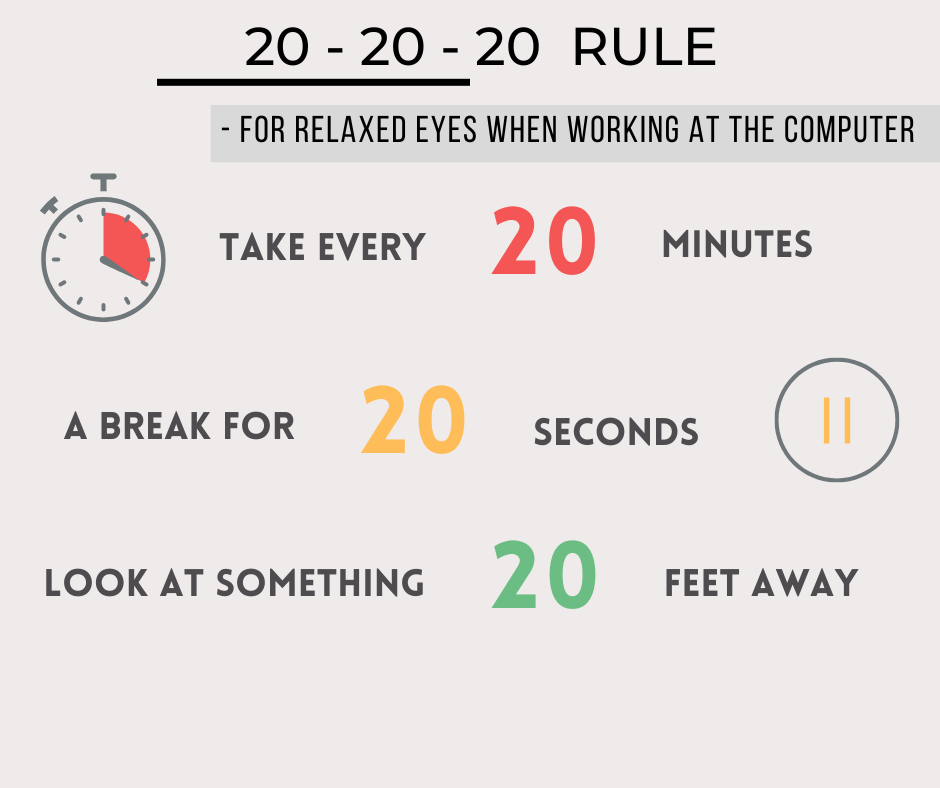
2. the 20/20 rule
After looking at the screen for 20 minutes, let your eyes wander into the distance for 20 seconds. Alternating between near and far vision gives your eyes a chance to rest. Feel free to blink in between! 😉
To see well, your body also needs the right space, relaxation and movement
The second important problem when working at a computer is the rigid posture and the incorrect posture we adopt when sitting in front of the monitor. Any rigid and incorrect posture is harmful in the long term!

The mental concentration on the work task at the screen means that we usually remain motionless in a position that we subjectively perceive as comfortable, but which is usually poison for the back.
This can lead to tension in the neck, shoulders and back.
Lack of exercise makes you see worse!
But not only that! It also affects the visual system, as nerve pathways lead from the body to the brain and the eyes and supply them. If the supply is blocked by an incorrect posture, your eyes are not supplied with enough impulses.
That's why the ergonomics of your workplace are also crucial for the health of your eyes.
Take a break!
It is very important that you take short breaks, move around a little every now and then, stretch and relax.
Treat yourself to a little break and do the Chinese acupressure exercise with Myriel! You'll immediately feel fresher and more relaxed. Click here: Pressure acupressure exercise.
To help you remember to take your well-earned breaks regularly, there are tools to remind you and give you a break.
> Mac: TimeOut
> Windows: FadeTop
A quick tip first:
Make sure that the monitor is 60-80 cm away from your eyes. So don't stare at it too closely. Keep your distance!
Computer-tired eyes exhaust the whole body!
According to estimates by the American National Institute for Occupational Safety and Health (NIOSH), 80 percent of people who spend three or more hours a day at a computer suffer from fatigue.
The main causes of this exhaustion are: Overuse of our eyes, lack of exercise and poor working posture.
So to stay healthy and vital, take care of it! Start making the first changes!
The good news is that most vision problems that can be attributed to computer work are reversible.
If you make an early effort, this will mean that you work with more concentration
you are more efficient
your eyes feel fresher
your eyes focus easily at different distances
you are still motivated to go about your day after work
you feel comfortable and relaxed
Overall, your whole health and well-being will benefit. So do something about it! 😉

INFORMATION
93% of our members recommend us!


*The rate of success from vision training is different from individual to individual and is not guaranteed.